Parenting
How do you help children who are afraid of failing?
Some children avoid things, give up quickly or refuse to try—not because they lack motivation, but because mistakes feel too risky. Here are eight practical ways to help your child find the courage to try.
By Evalotta Eriksson · Published 26 June 2026 · Read in Swedish
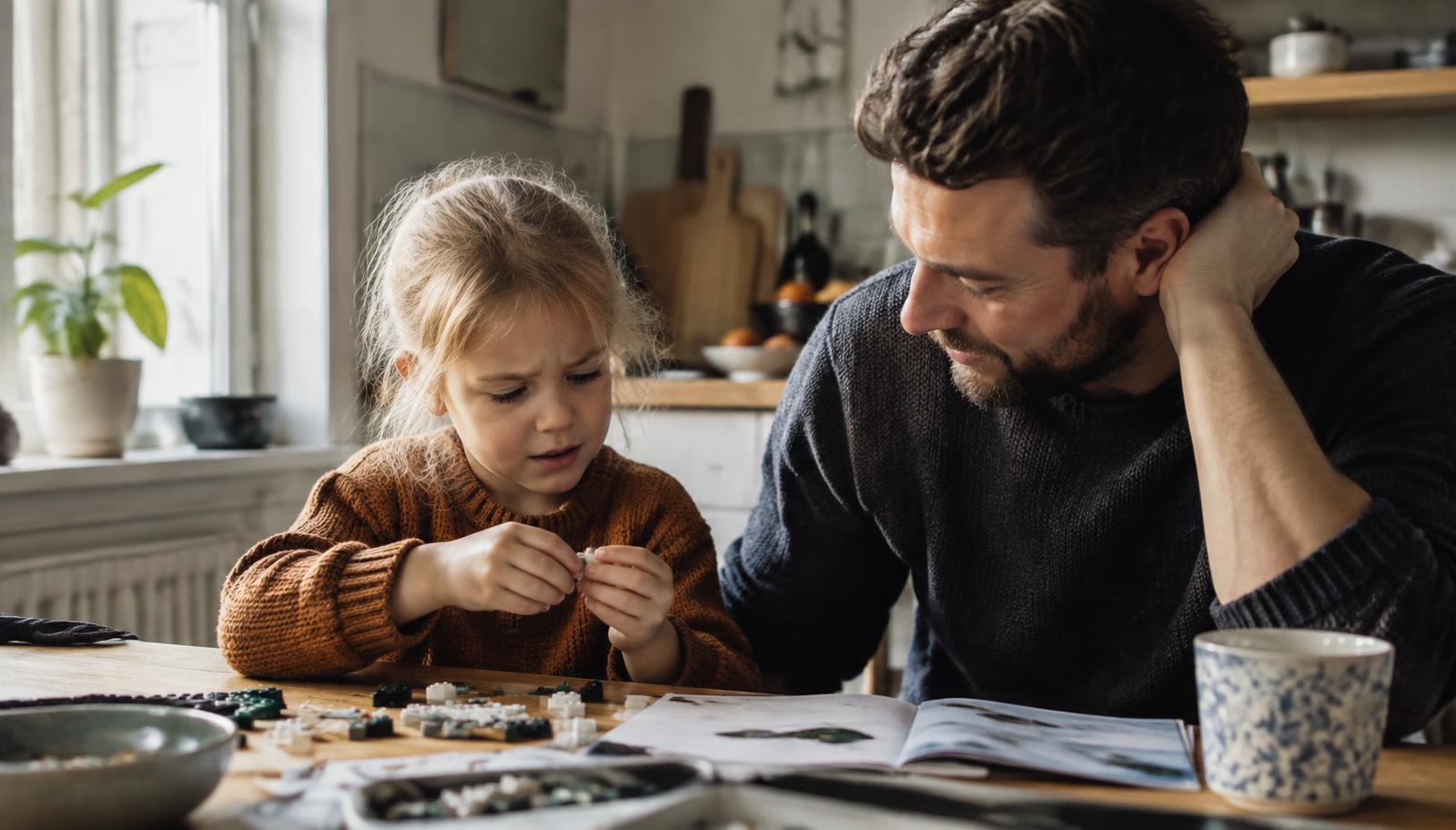
I don't want to.
You know your child actually wants to. But when it is time to try, you hear:
I can't.
I'm bad at it.
It's boring.
Sometimes it is not about a child lacking motivation. It may be that not trying feels safer than trying and failing. If I don't try, I never have to find out whether I can do it.
Fear of failure can therefore show up in many ways. Your child might avoid new activities, give up very quickly, get angry when something goes wrong, want to be the best right away, compare themselves with others a lot or say something is "boring" as soon as it becomes difficult.
As a parent, the question is then not just How do I get my child to try? but also How do I help my child feel that it is okay not to succeed right away?
Why are some children so afraid of getting things wrong?
There can be many reasons. Children are different. But one important factor is what failure begins to MEAN to the child.
One child might think: I failed at the task.
Another: I'm no good.
The same event. Completely different meanings. When mistakes start to feel like a threat to a child's self-image, trying to avoid them makes sense. This is closely connected to your child's self-esteem.
When "I can't" really means "I'm afraid to fail"
Children sometimes say I can't. But what they really mean may be I don't know whether I'll be able to do it.
That is something entirely different. Nobody knows whether they will succeed before they try.
Help your child add one little word: yet.
"I can't" becomes I can't yet. This is not a guarantee that your child will succeed. But it opens the door to development.
8 ways to help children who are afraid of failing
1. Don't turn the feeling into a problem
Your child says I'm nervous. Avoid automatically replying You don't need to be! Your child IS nervous, after all.
Instead, try: I understand. This is something new, and you don't really know how it will go.
You do not need to remove the feeling for your child to be able to act.
2. Separate the person from the performance
Your child got a poor result on a test. That means your child got a poor result on a test. Not that your child is no good.
Your child lost the match. That means your child lost the match. Not that your child is a loser.
Help your child separate What happened? from Who am I?
3. Be curious about mistakes
When something goes wrong, ask: What do you think happened? What did you learn? What would you try next time?
Now the mistake becomes information. Not a verdict.
4. Let your child see your own mistakes
Children do not just need to hear that it is okay to get things wrong. They need to see adults live that way.
Oops, I got that wrong. I'll have to try again.
This shows that mistakes can be handled.
5. Avoid rescuing your child too quickly
Your child tries. It does not work. You know exactly how to solve the problem, and it is tempting to take over.
But sometimes your child needs to stay with I don't know how to do this for a while. You can help without solving it: What could you try? or Would you like a hint?
This allows your child to retain some ownership—the same principle as in the article on how to help children become more independent.
6. Make the attempt smaller
If the task feels enormous, your child may avoid the whole situation. Ask: What is the smallest possible step?
Your child may not need to play the whole match, speak in front of the whole class or try everything at once. Courage does not always mean doing the biggest thing possible. Sometimes courage means taking the next step despite the uncertainty.
7. Pay attention to your own focus on results
You may never say You have to win. But your child still notices what gets the most attention.
Do you always ask about the result first after a match? About the grade after a test? Is your response much bigger when your child wins than when they have made a brave attempt but lost?
Children read more than our words. They notice what we seem to value.
8. Let your child experience that failure passes
Your child tries. Fails. Feels disappointed. And then something happens: life goes on. The family is still there. The next day arrives. Your child gets to try again.
That is a valuable experience: I failed—and I coped with it. You can read more about this in the article on how to help children handle failure.
Children who want to be the best right away
Some children love things they can already do, but avoid things they have not mastered. This might sound like I hate tennis after ten minutes, or This is really boring when a task becomes difficult.
Sometimes the child is protecting their self-image. If I stop before I really try, I can think: I could have done it if I'd wanted to.
As a parent, you can help your child see the beginner stage as normal: It makes complete sense that you can't do this yet. You've only just started.
When your child gets angry about losing
Anger can sometimes sit on top of something else: disappointment, shame, frustration or fear of not being good enough.
That does not mean every behaviour is okay. Your child is allowed to feel angry, but that may not mean they are allowed to hit someone, break things or say whatever they like. You can both set a boundary and help your child understand the feeling—see the article on strong emotions in children.
Should you let children win?
You do not need to create a world where your child always succeeds. Losing a game with a trusted adult can actually provide a small opportunity to practise.
Your child gets to feel the disappointment and frustration—and then discover: It passed.
What matters is not that your child never loses. It is how you handle the loss together.
When your child compares themselves with others
She's much better than me.
Perhaps she is. You do not always have to disagree. Instead, try: What would you like to get better at?
Now you are shifting the focus from judgement to development. Someone else can be better today without that saying everything about your child's future ability.
When high expectations come from the child
Sometimes the parents are relaxed. But the child places enormous demands on themselves.
I have to get every answer right. I have to win. It has to be perfect.
Then it can be useful to ask: What would happen if it wasn't perfect? Not to argue, but to understand what your child is actually afraid of.
Praise courage—not just results
A child does something they have been nervous about. The result is not particularly good. This is a perfect opportunity to point out:
You were nervous, and you did it anyway.
That is different from You did so well! You are helping your child recognise an ability that is useful far beyond that particular performance: acting despite uncertainty.
Person versus performance
One of the most important things we can help children understand is: You are not your latest result.
Your child can fail a test, miss a penalty, lose a competition, forget a line or embarrass themselves—and still be the same person afterwards. The same principle applies in sport, as described in the article on person versus performance.
As that foundation becomes more secure, finding the courage to try also becomes easier. Because the risk changes. There is no longer as much at stake for their identity.
A simple exercise: this week's brave attempt
Try this once a week. Everyone in the family gets to answer:
What did I try to do even though I didn't know whether I would succeed?
What happened?
What did I learn?
Parents should take part too. Now you are recognising not only what you succeeded at, but also what you dared to try.
The goal is not for your child to stop feeling afraid
If your child thinks I have to feel confident before I try, they could be waiting a long time.
Instead, the goal can be: I can feel uncertain and still take a step. That is a much more useful ability.
When might extra support be needed?
It is common for children to be afraid of failing sometimes. But if the fear becomes intense, persists over time and clearly limits your child's schooling, relationships, sport or everyday life, you should seek support from an appropriate healthcare professional or school health services. Growmaster's content and coaching do not replace healthcare or psychological treatment.
Summary
A child who is afraid of failing does not always need more confidence before trying. Sometimes, instead, they need experiences of trying, not knowing, making mistakes, feeling disappointed, learning and trying again.
Help your child separate the person from the performance. Normalise mistakes. Be curious rather than immediately correcting. Let your child work things out independently. Recognise brave attempts. And show through your own behaviour that mistakes can be handled.
The goal is not I will always succeed. A stronger foundation is I dare to try even when I don't know how it will go.
Would you like to develop how you approach performance and setbacks as a parent?
Children are influenced not only by what we say, but also by how we handle demands, mistakes and uncertainty ourselves. Growmaster helps you understand your own patterns and develop a more conscious approach to self-leadership.
Book a free 15-minute introductory call with Evalotta, or read more about individual coaching.
Frequently asked questions
How do you help a child who is afraid of failing?
Normalise mistakes, focus on learning and help your child take smaller steps rather than requiring the fear to disappear before they try.
Why does my child give up as soon as something becomes difficult?
There can be several reasons. Sometimes stopping quickly can be a way to avoid the feeling of not being able to do something or the risk of failure.
What do you say when a child says "I can't"?
Be curious about what your child means. In some situations, "I can't yet" can help distinguish their current ability from what they can learn in the future.
How do you help children find the courage to make mistakes?
Show through both your words and your own behaviour that mistakes are a normal part of learning. Let your child try, get things wrong and take part in finding the next solution.
How do you help children who place high demands on themselves?
Try to understand what your child thinks would happen if the result were not perfect. Also help your child separate their worth as a person from an individual performance.
Should you praise children when they try?
It can be valuable to recognise courage, persistence and learning, but do so in a specific and genuine way rather than mechanically praising every attempt.