Parenting
How do you stay calm when your child does not listen?
Being a calm parent is not about never getting angry, but about what you do when frustration arises. Here are eight practical ways to manage your own reaction, communicate more clearly and repair the relationship afterwards.
By Evalotta Eriksson · Published 19 February 2026 · Read in Swedish
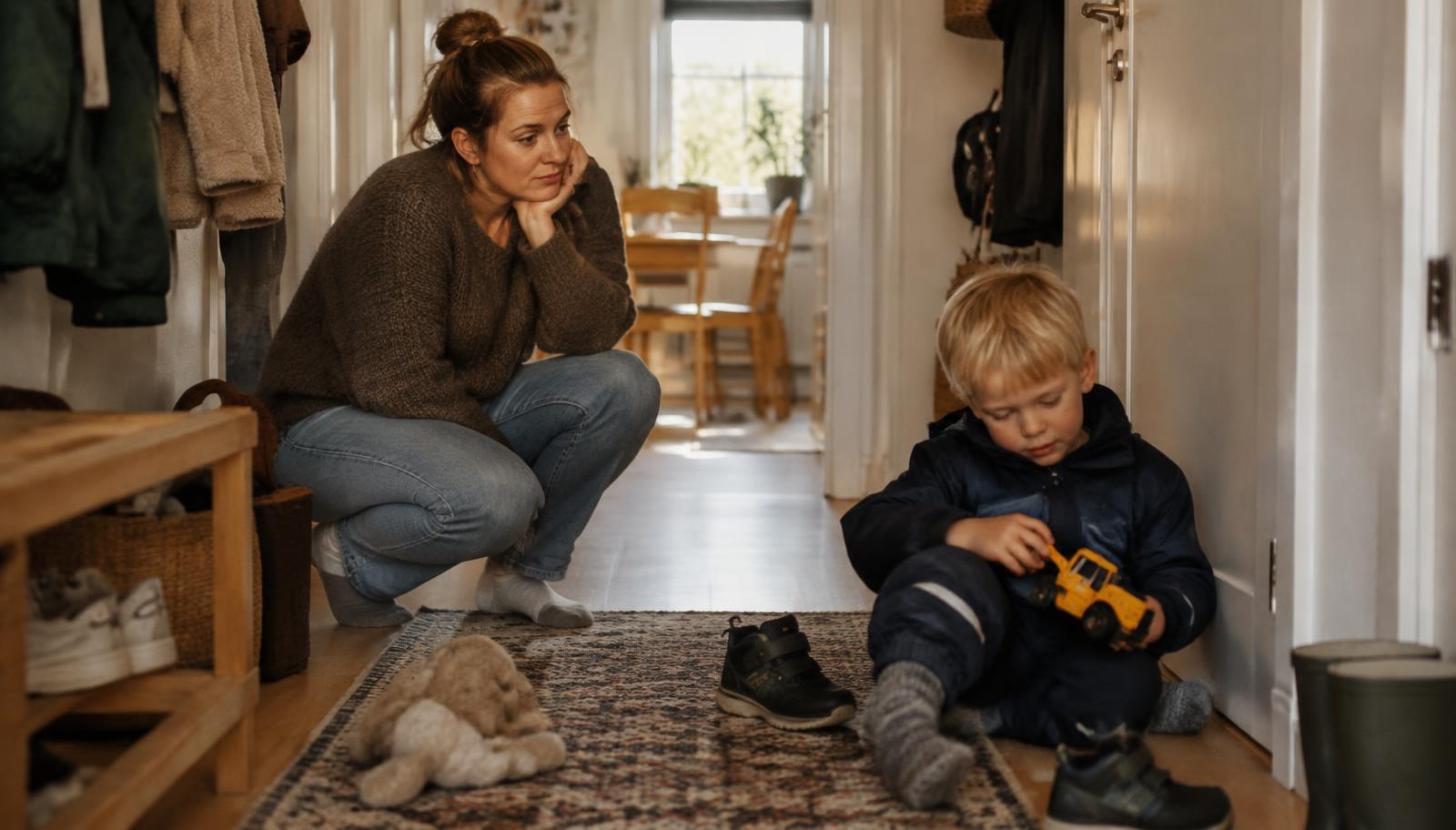
Put your shoes on.
Nothing happens.
We need to leave now. Put your shoes on.
Still nothing. You look at the clock. You are already late.
I have said it three times now!
Your voice gets louder. Your child gets angry. You become even more frustrated. And suddenly, the situation is no longer about a pair of shoes.
Most parents recognise some version of this. Staying calm with your child is easy in theory. It is considerably harder when you are tired, stressed, late, hungry, worried or have already said the same thing five times.
That is why calm parenting is not about never getting angry. It is about what you do when frustration arises.
Why do you get so frustrated when your child does not listen?
It is rarely just your child's behaviour that affects your reaction. You might also be thinking:
Why can she never just do what I say?
He should understand this by now.
We are going to be late again.
So there is more to the situation than your child not doing what you ask. There is also your interpretation, your stress, your expectations, your emotion — and then your action.
This is where self-leadership comes in.
You cannot always control your child's reaction — but you can practise managing your own
As a parent, you naturally want to find the right words that will make your child immediately listen, understand, calm down and cooperate. But it does not always work that way. Children are people with their own wishes, emotions, needs and reactions.
You can influence the situation. But you cannot control every reaction. What you can develop, however, is how you act when the situation becomes difficult.
8 ways to stay calm when your child does not listen
1. Notice your own reaction earlier
Anger rarely goes from zero to a hundred in a second. You might tense your jaw, start speaking faster, raise your voice, feel heat in your body or repeat the same sentence more harshly.
The idea is not to stop the emotion. The idea is to notice: I am starting to get really frustrated now. The earlier you notice it, the more opportunity you have to choose what you do next.
2. Create a brief pause
You do not always need to respond immediately. A pause might mean taking a breath, staying silent for three seconds, drinking some water, lowering your shoulders or stepping away briefly if the situation allows.
Three seconds will not resolve the conflict. But they can create a little space between what you feel and what you do.
3. Lower your voice instead of raising it
When your child does not respond, the automatic solution is often to speak louder. But a louder voice does not automatically mean clearer communication.
Instead, try moving closer, getting your child's attention, using their name and briefly saying what needs to happen.
Ella, look at me. Let's put your shoes on now.
Fewer words can sometimes work better than a long lecture. This is much like what is described in the article on how to get children to cooperate without nagging.
4. Think about what "listen" means
When we say My child never listens, what we often really mean is My child does not do what I ask.
Your child may well have heard you. But they want to keep playing, avoid brushing their teeth, stay with their friend or keep the screen on. In that case, the problem is not necessarily hearing or understanding — there is a clash of wills.
That does not mean your child gets to decide. But it can help you understand the situation better.
5. Acknowledge the feeling without letting go of the boundary
You can say: I understand that you want to keep playing.
And then: Screen time is over now.
Both can be true at the same time. Understanding your child's feelings does not mean they always get their way. Empathy and boundaries are not opposites — this is explained in more detail in the article on how to set boundaries for children.
6. Avoid making the situation bigger than it is
As frustration rises, words such as always, never and every time can easily slip out.
Why do you ALWAYS have to do this?
Now the conflict is no longer about what is happening. Your child's entire history of behaviour has been brought into it. Try to stick to this situation. Not the past six months.
7. Adjust your expectations to the situation
A tired child at 7.30 pm may not have the same capacity to cooperate as they do at 10 in the morning. And a stressed parent may not have the same patience after a long working day.
That does not mean boundaries disappear. But realistic expectations can reduce unnecessary conflicts. Ask: What is reasonable for me to expect right now?
8. Repair the relationship when you lose your patience
Sometimes you will raise your voice, say something you regret or react more harshly than you intended. Parenting is not about perfection.
When that happens, you can come back:
I got very angry and shouted. That was not how I wanted to speak to you. I was frustrated, but I could have handled it differently.
You do not need to pretend that your child's behaviour was okay. You can still maintain the boundary. But you can take responsibility for your own part.
Do children always have to listen straight away?
It is easy to imagine that a "well-adjusted" child does everything an adult says the first time. But children develop independence, a will of their own, impulse control, emotional regulation and the ability to switch activities at different rates.
Sometimes you need to repeat yourself. Sometimes your child needs help finishing what they are doing. And sometimes your child will protest even when the boundary is reasonable.
So the goal does not have to be My child never protests. A more realistic goal might be I can be clear even when my child protests.
When you are stressed yourself
Think about the same situation on two different days.
Day one: you have plenty of time. Your child cannot find their shoes. You help.
Day two: you should have left five minutes ago. You have an important meeting. Your child cannot find their shoes. Suddenly, the same problem feels enormous.
Your child did not necessarily change. The pressure you were under did. That is why an important question is: What is happening inside me right now? If everyday stress often takes over, the article on how to manage stress may be a good next step.
"I do not want to shout — but it just happens"
When the same situation repeats itself, your reaction can become almost automatic. Your child does X. You think Y. Feel Z. And react.
One way to begin changing the pattern is to analyse the situation afterwards. Not to judge yourself, but to understand.
What happened just before I lost my patience?
What was I thinking?
What did I feel in my body?
What did I do?
What would I like to do next time?
Now you are starting to work on the pattern instead of simply hoping that next time will be different.
Setting boundaries without getting angry
A boundary does not automatically become better because it is expressed more harshly. You can be both calm and firm.
I hear that you do not want to go home. We are going home now.
Your child may still get angry. That does not automatically mean the boundary was wrong. Your job is not always to make your child like the boundary. Your job may be to maintain it in a way that feels as safe and clear as possible.
When your child is also very angry
When both child and parent are in a heightened emotional state, problem-solving often becomes harder. This may not be the right moment for lengthy explanations, moral lectures or discussions about next week.
Sometimes the situation needs to calm down first. The conversation can come later. You can read more about this in the article on how to help children manage strong emotions and in the article on conflicts with your child.
Parenting and self-leadership
It is easy to think that parenting is mainly about getting your child to do the right thing. But an equally interesting question is:
How do I lead myself when my child does not do what I would like?
You cannot determine exactly what your child feels, what they think or how quickly they calm down. But you can practise how you communicate, how you manage your frustration, which boundaries you set, how you repair the relationship after conflict and how you act when things get difficult.
That is self-leadership in practice.
A simple Growmaster pause for parents
When you notice your frustration rising:
STOP — What is happening right now?
NOTICE — What am I thinking? What am I feeling?
CHOOSE — How do I want to act?
Not What do I feel like doing? but How do I want to be in this situation?
It does not have to take a minute. Sometimes a few seconds are enough. But those seconds can change your next action.
If you have already lost your patience
The day is not ruined. The relationship is not ruined.
Go back. Take responsibility. Repair the relationship. Then think about what you can do differently next time.
Growth does not happen by never making mistakes. It happens by noticing, understanding, adjusting and practising again.
Summary
When your child does not listen, it is easy to focus all your attention on them. But sometimes the most important opportunity for growth lies elsewhere. With you.
Notice frustration earlier. Create a pause. Communicate more briefly and clearly. Acknowledge the feeling without automatically letting go of the boundary. Stick to the current situation. And when you react in a way you are not happy with: repair the relationship and try again.
Being a calm parent does not mean never getting angry. It is about getting better at what you do with anger when it arises.
Would you like to develop your self-leadership as a parent too?
Sometimes we know how we want to act but still react differently when stress or frustration takes over. Growmaster helps you understand your own patterns and develop tools for making more conscious choices in everyday life.
Book a free initial 15-minute conversation with Evalotta, or read more about individual coaching.
Frequently asked questions
What do you do when your child does not listen?
First, try to get their attention and give a short, clear instruction. Also consider whether your child has not understood, cannot do it at that moment or is simply protesting against what you are asking.
How do you stay calm when your child makes you angry?
Try to notice your early signs of frustration and create a brief pause before reacting. A breath or a few seconds of silence can give you more opportunity to choose how you want to act.
How do you stop shouting at your children?
Start by identifying which situations most often lead you to raise your voice. Stress, lack of time and recurring conflicts can be important triggers. Then practise an alternative behaviour before the next situation arises.
How do you set boundaries without getting angry?
Be brief, clear and consistent. You can acknowledge your child's feelings while maintaining the boundary. Your child does not have to like the boundary for it to be reasonable.
What do you do if you have shouted at your child?
Once the situation has calmed down, you can take responsibility for how you acted and repair your connection. At the same time, you can stand by the original boundary.
Why do I get angry with my child so easily?
Your own reaction can be influenced by factors such as stress, tiredness, expectations and how you interpret your child's behaviour. If anger or conflicts become difficult, recurring or have a major impact on the family, professional support may be appropriate.